Rx Destroyer: What it is and When to use it
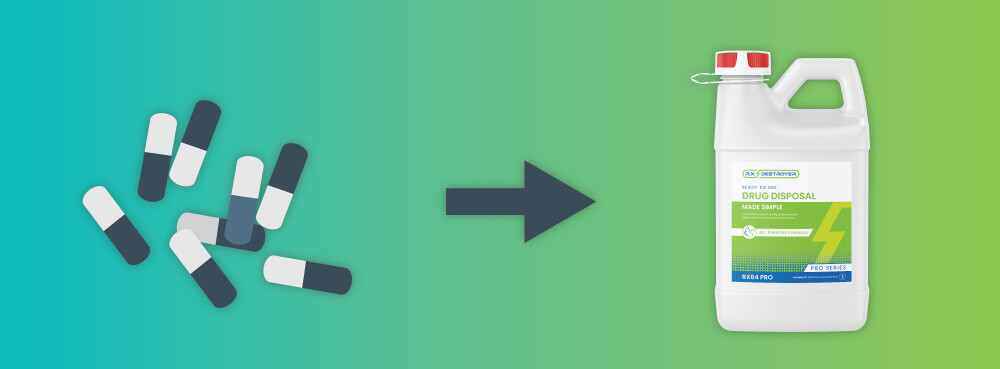
A pharmaceutical disposal process only works when healthcare personnel can follow it consistently. Facilities need a practical way to manage unused and partially administered medications while supporting diversion prevention, staff safety and applicable regulatory requirements.
Rx Destroyer gives healthcare teams a ready-to-use way to deactivate unwanted medications using activated carbon. It can support point-of-use medication disposal and broader pharmaceutical waste programs when incorporated into facility policies, documentation requirements and downstream waste-management procedures.
What is Rx Destroyer?
Rx Destroyer is a pharmaceutical drug deactivation system designed to provide a practical method for managing unwanted medications. Its ready-to-use formula requires no added water, batteries or preparation.
Options include All Purpose and Liquid formulas, Pro Series products for healthcare environments, multiple container sizes and Secure Mounting accessories. Organizations can select a configuration based on their medication profile, disposal volume, available space and workflow.
Rx Destroyer uses adsorption-based drug deactivation to render controlled substances non-retrievable, the standard required by 21 CFR 1317.90. The Drug Enforcement Administration (DEA) does not approve specific products or methods of destruction. Instead, the regulation requires the selected method to produce a non-retrievable result.
Within a facility’s established disposal program, Rx Destroyer supports point-of-disposal deactivation and witnessed medication-waste procedures while helping reduce opportunities for diversion or unauthorized access. It does not replace facility policies, chain-of-custody controls, required records or downstream disposal requirements.
How Does Rx Destroyer Work?
Rx Destroyer combines a wetting and dissolving solution with activated carbon. The solution promotes contact between the medication and the carbon’s extensive surface area, where pharmaceutical compounds are adsorbed and rendered non-retrievable.
Adsorption occurs when a substance adheres to another material’s surface. It differs from absorption, in which a substance is taken into another material’s volume. With Rx Destroyer, pharmaceutical compounds are adsorbed onto the activated carbon.
When should Rx Destroyer be used?
The appropriate application depends on the medication, facility, waste classification and applicable requirements.
Partial-dose and witnessed medication waste
Healthcare personnel may use Rx Destroyer to deactivate unused portions of administered medications at the point of disposal when permitted by facility policy. For controlled substances, personnel must continue following the organization’s witnessing, documentation and chain-of-custody procedures.
Expired, damaged or unused inventory
Inventory disposal may be subject to requirements that differ from partial-dose waste. Depending on the circumstances, the appropriate process may involve reverse distribution, qualifying on-site destruction or another authorized pathway.
DEA registrants should not assume that partial-dose procedures satisfy inventory-destruction requirements. Inventory destruction may carry additional documentation, witnessing and recordkeeping obligations under 21 CFR 1317.95.
Other pharmaceutical disposal applications
Rx Destroyer may also be used for compatible non-controlled medications. The facility should determine whether the medication is a hazardous or non-hazardous waste pharmaceutical before selecting a downstream waste stream. Products are also available for ultimate users and community programs, where different requirements may apply.
Choosing the appropriate formula and configuration
The All Purpose formula is designed for workflows in which approximately 70% or more of disposed volume is solid. Compatible forms may include pills, capsules, tablets, lozenges, patches, powders, suppositories, limited liquid medication and cannabis waste.
The Liquid formula is designed for workflows in which approximately 70% or more of disposed volume is liquid. It may be appropriate for injectable waste, medication dispensed from syringes and clinical areas generating higher liquid volumes.
Needles, syringes, glass and packaging should not be placed into the container unless expressly permitted by the applicable product instructions.
Pro Series products include a tethered cap, viewing gauge and square-bottle design. Wire Mounts and Lock Boxes can establish a dedicated location and provide additional protection against unauthorized removal.
How do you use Rx Destroyer?
Always follow the applicable product label and facility policies.
Step 1 / Confirm the workflow
Determine whether the medication is controlled or non-controlled and whether it is classified as hazardous or non-hazardous pharmaceutical waste. Complete required witnessing and documentation.
Step 2 / Add the medication
Remove the medication from unnecessary packaging and place the compatible medication into the container.
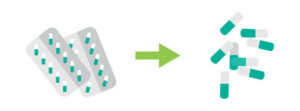
Step 3 / Secure and agitate
Close the cap and gently agitate the container so the formula contacts the medication.

Step 4 / Manage the full container
When the container reaches its indicated capacity, secure the cap and manage it according to product instructions, the facility’s waste determination and applicable requirements. If hazardous pharmaceuticals are present, label the container as hazardous waste and arrange collection through an appropriately authorized hazardous-waste service.
Hazardous, non-hazardous or controlled?
These classifications describe different regulatory categories and should not be used interchangeably.
Hazardous waste pharmaceuticals are regulated under the Resource Conservation and Recovery Act (RCRA). A pharmaceutical may be hazardous because it appears on an Environmental Protection Agency list or exhibits a hazardous characteristic. State requirements may be more stringent. These wastes must be managed under applicable requirements, including 40 CFR Part 266 Subpart P.
Containers holding medications determined to be hazardous waste pharmaceuticals must enter the facility’s hazardous pharmaceutical waste program and be transferred through an appropriately authorized waste service.
Drugs on the National Institute for Occupational Safety and Health (NIOSH) List of Hazardous Drugs may require additional handling controls to protect personnel. A NIOSH listing does not, by itself, determine whether the discarded medication is regulated as hazardous waste under RCRA. Facilities should evaluate both occupational-safety considerations and applicable waste-classification requirements.
Non-hazardous waste pharmaceuticals are unwanted, contaminated or expired medications that are not federally classified as hazardous waste and do not exhibit a hazardous characteristic. State or local requirements may still apply.
Controlled substances are regulated by the DEA and may be either hazardous or non-hazardous under environmental regulations. Therefore:
· Not all controlled substances are hazardous waste.
· Not all hazardous waste pharmaceuticals are controlled substances.
· Some medications fall into both categories.
· Regulated medical waste is a separate category and should not be used as a general term for pharmaceutical waste.
Why formulary analysis matters
A formulary analysis helps identify medications that are hazardous, non-hazardous, controlled or subject to overlapping requirements. This can guide segregation, container selection, documentation and downstream management.
Daniels Health works with healthcare organizations to evaluate pharmaceutical waste streams, map disposal points and develop practical waste-management workflows around their actual medication inventories.
Build a pharmaceutical disposal program around your facility
Medication types, disposal volumes and waste classifications vary across healthcare environments. A successful program should account for the organization’s formulary, clinical workflows, security needs, documentation practices and downstream requirements.
Speak with a Daniels Health pharmaceutical waste specialist to discuss your facility’s medication-disposal needs.

Laura Wakelam
Let's Talk!
Your time is valuable, and we don’t want to play hard to get. You can either phone us directly on the details listed on our contact page, or feel free to fill out this short form and one of our team members will get back to you as quickly as possible.