Preparing Healthcare Facilities for New World Screwworm Waste
Healthcare facilities spend time preparing for emerging infectious diseases, including what happens after patient care. Having a clear, compliant waste management process is an important part of protecting healthcare workers and the community.
Ashley Perry, Director of Hazardous Waste Services at Daniels Health joined host Jill Morgan on NETEC’s Transmission Interrupted podcast to discuss New World screwworm, the risks it presents and what healthcare facilities should know about managing waste from a suspected case.
Perry focused the conversation on a vital question: What happens after the specimen leaves the patient?
WHAT YOU SHOULD KNOW:

What Is New World Screwworm?
New World screwworm is a parasitic fly that can affect livestock, wildlife, pets and humans. Its larvae enter living tissue and can burrow deeper into wounds as they develop.
Historically, the parasite has been controlled in the United States, but has recently been moving northward. For healthcare providers, that means knowing how to properly handle patients with larvae or eggs in a wound, even before the species has been confirmed.
A Suspected Case Put Preparedness into Practice
Perry’s involvement started when a Daniels Health customer in the southwestern United States treated a patient with larvae in an infected wound. Concerned it could be New World screwworm, the facility reached out for help determining how the resulting waste should be handled.
Testing later confirmed it was not New World screwworm. Still, the situation gave Perry and the customer an opportunity to look closely at their process and prepare for a future suspected or confirmed case.
“We still wanted to treat the waste as if it was, just to be safe, which is what I would always recommend” Perry said.
At Daniels, we understand how important it is to have a plan in place for those rare moments.
One Case = Two Waste Streams
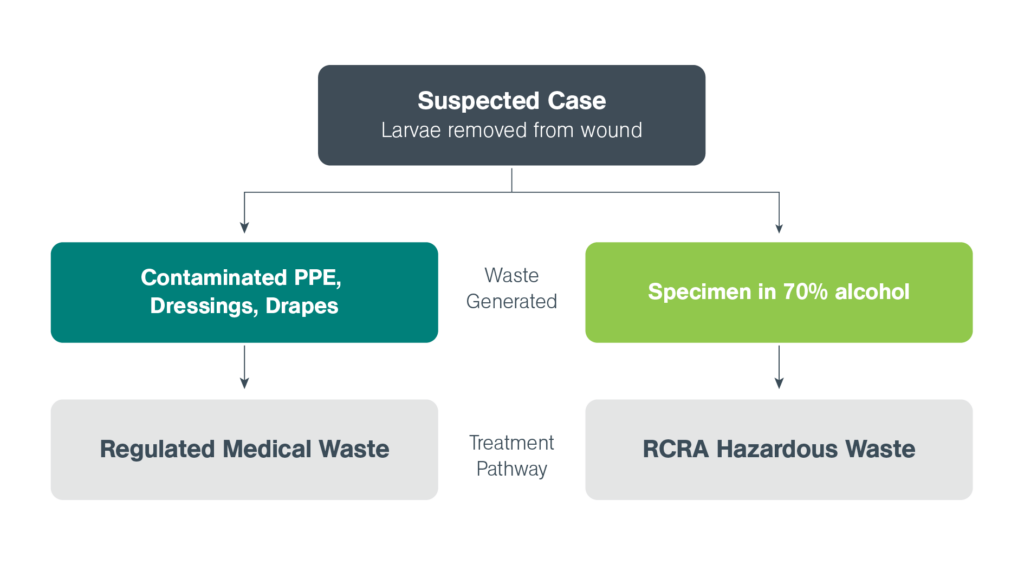
What happens when larvae are removed from a patient?
Perry discussed CDC guidance for collecting larvae for identification, including preserving specimens in a leak-proof container with at least 70% ethanol or isopropyl alcohol. The use of alcohol introduces an additional waste consideration because it can exhibit the ignitability characteristic under the Resource Conservation and Recovery Act (RCRA).
This means a potential case may generate more than one type of waste. Contaminated PPE and other patient care materials may be managed through the facility’s regulated medical waste process, while specimens stored in alcohol require separate consideration. This distinction between regulated medical waste and hazardous waste is consistent with Daniels’ approach to proper waste segregation.
“There’s two distinct waste streams that get generated here, which is a little bit different than maybe some Category A infectious waste or other types of pathogen waste where you’re typically generating one waste stream.”
Understanding the difference before a case occurs can help prevent materials from being placed in the wrong container or sent through an inappropriate treatment process.

Prepare Your Teams Before They Need the Process
With rare cases, it is important to keep the process straightforward for clinical teams. Healthcare workers need to stay focused on patient care without having to make complicated waste segregation decisions at the bedside.
Because of this, Perry recommends reviewing procedures in advance and involving the teams responsible for waste management, including EVS, Environmental Health and Safety, laboratory teams and the facility’s waste partner.
Her advice was simple:
“If you are prepared then you don’t have to stress about it when it happens.”
A Trusted Partner for Unexpected Waste Challenges
New World screwworm may not be something healthcare teams encounter every day, but that is exactly why having a plan matters. Understanding the waste streams, knowing who to contact and confirming the disposal process ahead of time can help facilities respond safely and confidently to a suspected case.
At Daniels Health, we partner with healthcare facilities to navigate healthcare waste challenges streams, helping teams prepare before an unexpected situation occurs.

Erika Safrin
Let's Talk!
Your time is valuable, and we don’t want to play hard to get. You can either phone us directly on the details listed on our contact page, or feel free to fill out this short form and one of our team members will get back to you as quickly as possible.