Hospital Safety
Daniels Health’s ultimate mission is making “Making Healthcare Safer”, having no higher priority than the well-being of clinicians, healthcare workers, and patients.
 Redefining Hospital Waste Safety Norms
At Daniels, safety is the bedrock of everything we do. From our safety-first smart containers to scientifically validated and industry-first robotic washing systems, every solution we provide is designed to protect frontline staff, reduce risk of blood-borne illnesses and eliminate cross contamination. With globally attested peer-reviewed data and decades of clinician partnership across America’s leading hospital brands, we deliver systems that supercharge your safety and infection control standards.
How We Build Safety into Every Step
Our approach to safety is intentional and clinically led. From product design to education and data reporting, Daniels works alongside clinical staff and hospital leadership to ensure that the safety of healthcare is always the number one priority.
- Engineered to reduce needlestick injuries – Our industry leading Sharpsmart sharps container was developed through years of R&D and clinical research. Features include a hand-restricted tray, overfill protection, and temporary and permanent safety locks. Hospitals have reported an 86.6% reduction in container-related needlestick injuries after converting to Sharpsmart.
- Like-new-sanitization – Reusable containers are cleaned to a 6-log bacterial load reduction, 100 times higher than CDC requirements.
- Contamination-resistant design — Smooth, non-porous surfaces help prevent microbial build-up and simplify cleaning. Puncture-resistant ABS plastic helps prevent spills and penetration.
- Education that sticks – Training, awareness campaigns, signage, and SOPs reinforce safe behavior and compliance.
From the Start
Our commitment to safety and infection prevention began at the height of the AIDS epidemic. In 1986, Dan Daniels, our founder and CEO, saw the real danger that nurses faced disposing of needles in lackluster and unsafe containment options.
Motivated to protect these frontline healthcare workers, Dan sold his family business and invested every penny he had into creating a better solution. The result of that investment was the Sharpsmart, the world’s first clinically engineered reusable, engineered with 13 inbuilt safety features to reduce risk and protect frontline staff.
The vision didn’t stop at a container. Recognizing that infection control was as high as a priority as needlestick injuries, Dan invented a high-pressure robotic washing. He developed a high-pressure robotic washing technology that achieves a 6-log reduction, 100 times higher than CDC requirements, and expanded this safety-first mindset to every waste stream generated within clinically-facing hospital environments.
Under the continued leadership of Dan Daniels, we remain an industry North Star for safety and infection control standards.

Sharpsmart Container Safety Features
Gravity Balanced Safety Tray
The safety tray restricts hand access. Sharps are released away from the user into the collector; removing the risk of “bouncing” or rollback of sharps.
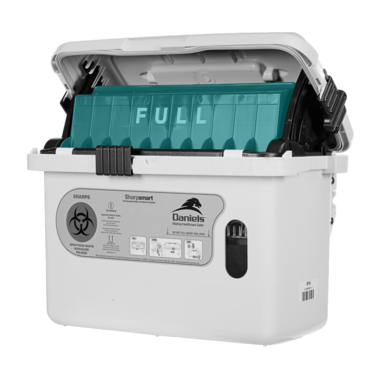
Maximum Strength Hardened Plastic
Impenetrable by contained sharps. Tested to an amazing 500 wash cycles, Daniels Sharpsmart is the only sharps container in the United States which has not had any FDA incident reports citing needle penetration.
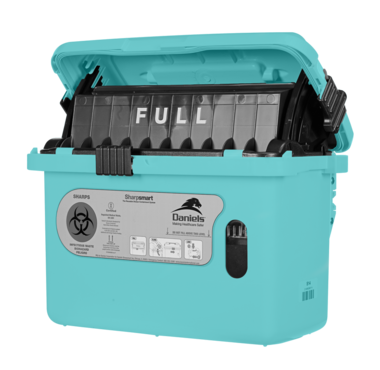
Check Content Levels
The Clearview window identifies the fill level of the collector without showing messy contents.
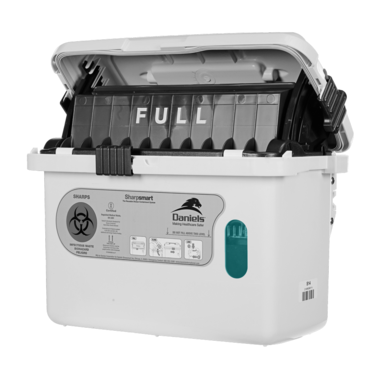
Temporary front lock
Temporary locking closure provides safe movement of collectors.
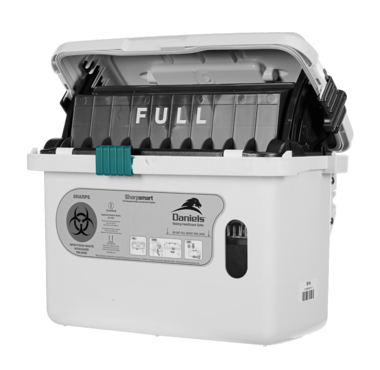
Wide Opening
The large aperture allows for single-handed disposal of sharps; the contents protection shield eliminates the risk of needlestick injuries.
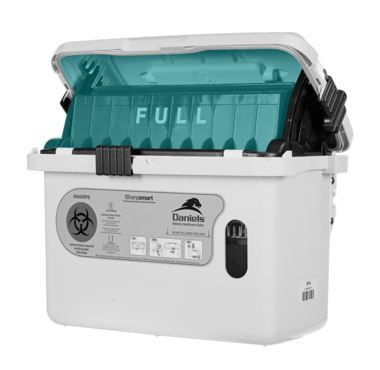
Eliminates Overfilling
Tray defaults to a FULL locked position when contents reach the maximum fill capacity, eliminating overfilling and associated risks.
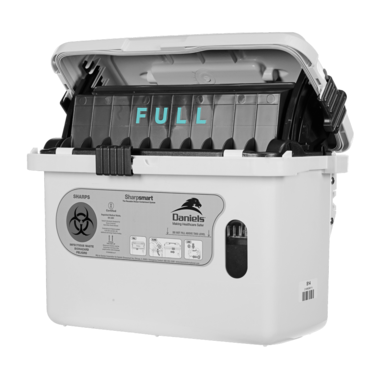
No-Leak Seal
Precisely engineered lid seal eliminates leakage of blood or body fluids during transport.
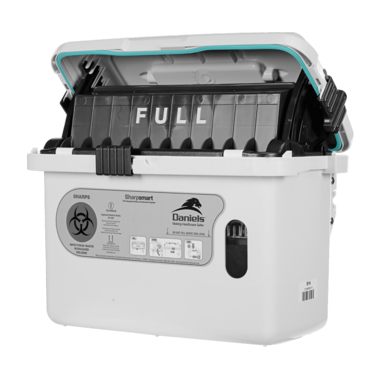
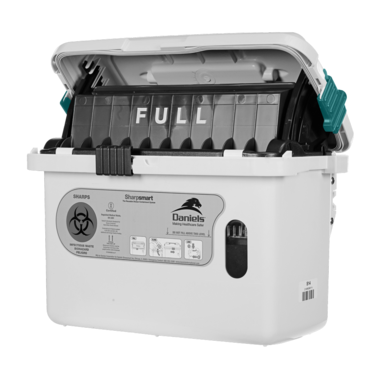
Tamper-proof
Permanent side locks prevent the collector from being reopened when full. Eliminates unauthorized access to contents.
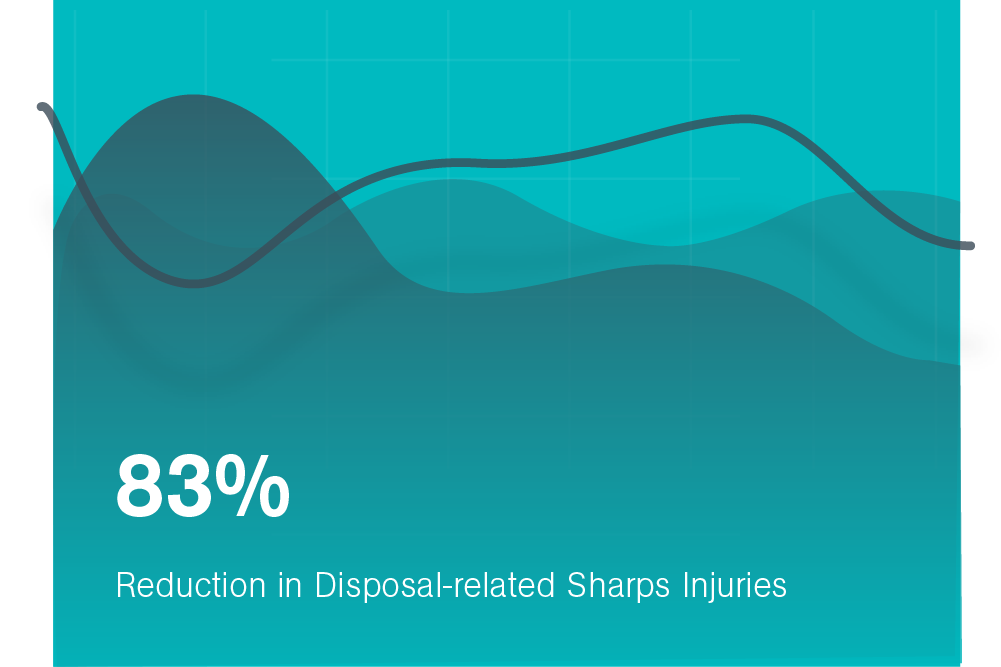
In 2 years with Sharpsmart, disposable related sharps injuries fell by 83.1%
A 6-year, 3-phase study compared the use of a small patient-room sharps disposal container with the Daniels Sharpsmart reusable container. In phase 1 of the study, the facility utilized disposable sharps containers and recorded 19.4% of sharps injuries being container-related. In phases 2 and 3 with the introduction of sharpsmart, container-associated sharps injuries were reduced to zero, disposal-related sharps injuries fell by 83.1%, and recapping sharps injuries were reduced by 85.1%.
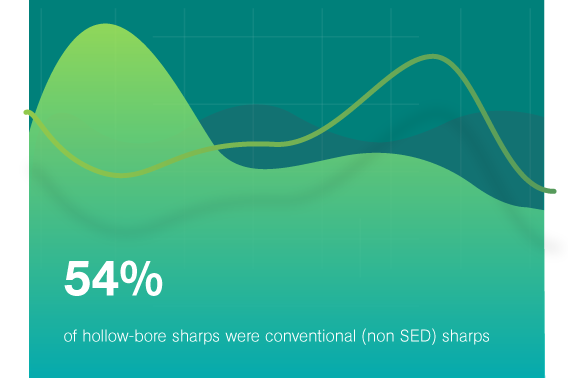
An audit of sharps containers revealed 42.5% of all devices were discarded ‘sharp’
A study took a sampling of sharps containers from five healthcare facilities in Florida. Contents were decanted, categorized and counted to identify the proportion of hollow-bore safety engineered devices (SED) among the sharps present, and the proportion of SED correctly activated. 69 Gallons of sharps from 18 sharps containers were examined, revealing 54.4% of hollow-bore sharps were conventional (non SED) sharps, 39.9% of conventional needles were capped, and 21.6% of SED were not activated or activated incorrectly.
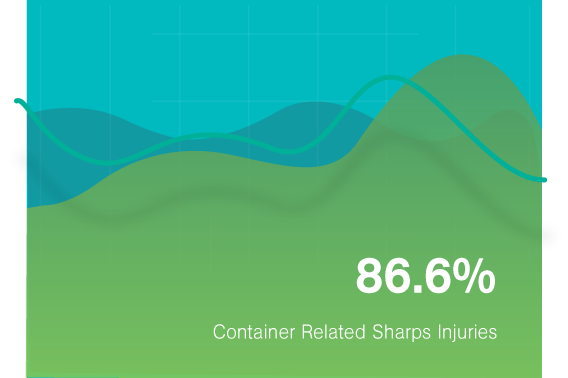
86.6% reduction in container-associated sharps injuries
A comparison of Daniels Sharpsmart sharps management system with 10 alternate sharps container brands
A study carried out in 8 acute care hospitals ranging in size from 150 to 850 beds in Australia, New Zealand and Scotland, compared Daniels Sharpsmart to 10 alternate sharps container brands. Upon implementation of the Daniels system, results revealed an 86.6% reduction in container-related sharps injuries, and a 25.7% reduction in non container-related sharps injuries.
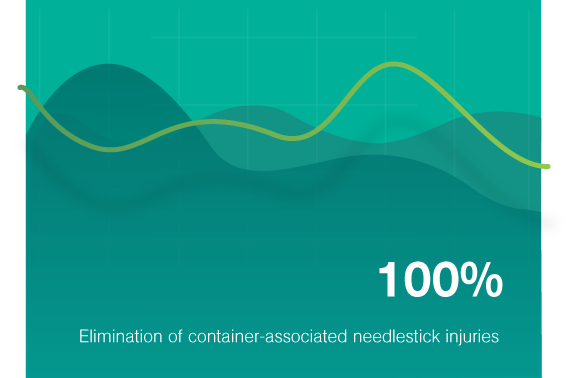
In 2 years with Sharpsmart, container associated sharps injuries were eliminated
A 6-year, 3-phase study compared the use of a small patient-room sharps disposal container with the Daniels Sharpsmart reusable container. In phase 1 of the study, the facility utilized disposable sharps containers and recorded 19.4% of sharps injuries being container related. In phases 2 and 3 with the introduction of sharpsmart, container associated sharps injuries were eliminated completely.
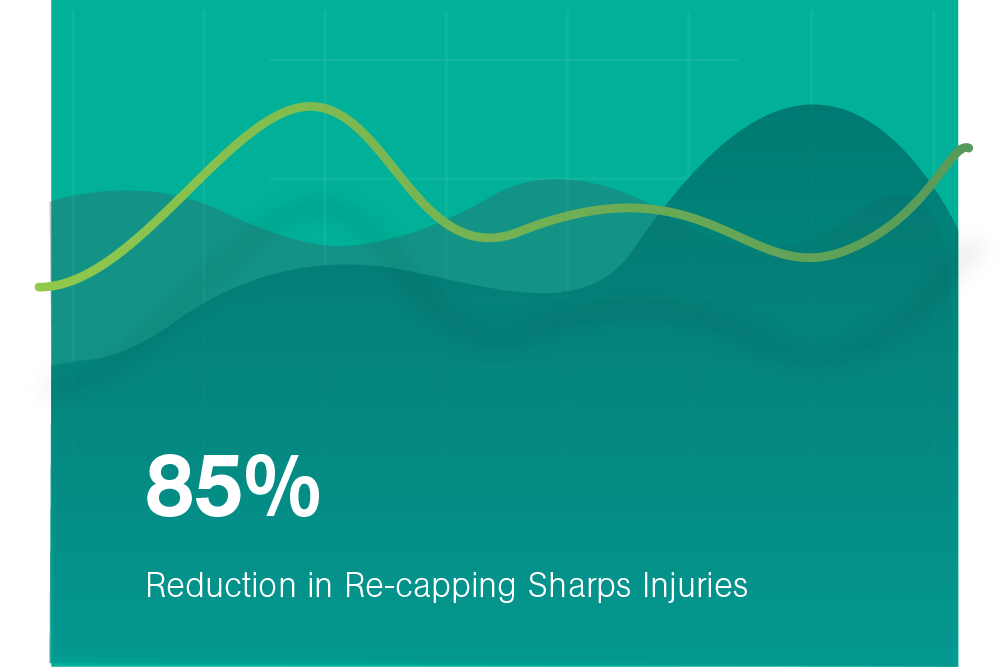
Recapping sharps injuries reduced by 85.1% with Sharpsmart
A 6-year, 3-phase study compared the use of a small patient-room sharps disposal container with the Daniels Sharpsmart reusable container. In phase 1 of the study, the facility utilized disposable sharps containers and recorded 19.4% of sharps injuries being container-related. In phases 2 and 3 with the introduction of sharpsmart, container-associated sharps injuries were reduced to zero, and recapping needlestick injuries were reduced by 85.1%.
Safety in Every Stream
From sharps to pharmaceuticals, trace chemotherapy and regulated medical waste, every Daniels container system has been designed with clinical intentionality; to protect frontline healthcare workers and those who inhabit the patient environment. Study after study, our safety engineered medical waste containers have been proven to significantly reduce needlesticks, occupational handling and exposure risks, and benchmark compliance minimums.
EXPO-S.T.O.P. “Fill the Gap” Survey
From 2019 to 2023, AOHP’s EXPO-S.T.O.P. “Fill the Gap” survey assessed sharps injury prevalence across 369 hospitals in 34 states. Findings show sharps injuries remain a persistent challenge.
- All-staff sharps injuries: roughly 2 out of every 100 hospital employees experienced a needlestick injury
- Nurse sharps injuries: nearly 4 per 100 in 2019–2020, decreasing to 3.6 per 100 in 2023
- Reporting trend: researchers flagged post-COVID under-reporting as a growing concern
Daniels Health is proud to be the exclusive sponsor of this research, helping bring visibility and benchmarking to sharps injury prevention across US hospitals.
Where Sharps Safety Delivers Measurable Impact
-

Sharpsmart: Impact of Engineering on Sharps Injuries
A 2 year, 28 hospital before-and-after study comparing sharps injuries in hospitals that converted to Daniels reusable system to those who did not.
-

Sharpsmart Sharps Containers: Impact on Emissions & Injuries
A 12 month study determining the effect of the Sharpsmart on greenhouse gas emissions and sharps injuries at the 500 bed Rotherham NHS Foundation Trust Hospital.
-

Reduction in Sharps Injuries, Costs, & CO2 Emissions
This article explores the positive impacts that the Sharpsmart system had on a 400 bed small acute trust, including a reduction in sharps injuries, a reduction in their carbon footprint, and cost and time savings for staff.
-

Reusable Sharps Containers: Impact on Infection Risk
This study examined literature and guidelines to determine the microbiological risk of using reusable sharps containers.
-
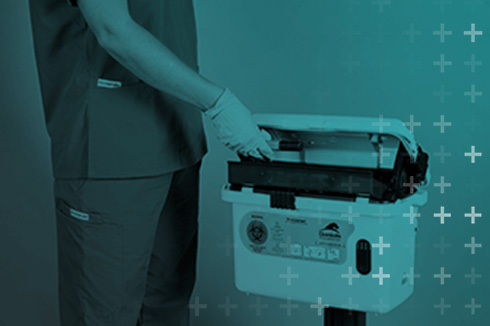
Needle stick Injuries in USA Health Care Facilities
This study carried out a survey of top ‘sharps safe’ occupational health professionals to ascertain BE incidence in their hospitals for the 2012 calendar year.
-
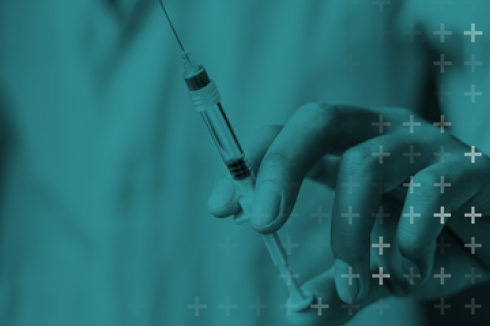
Safety Engineered Devices : Use and Activation in Six Western US Hospitals
A study into the activation rate and use of Safety Engineered Devices (SED) in 6 hospitals in US west.
-

Safety Engineered Devices: Use and Activation in USA
The study sampled sharps containers from 5 facilities to identify the proportion of hollow-bore SED among the sharps present, and the proportion of SED correctly activated.
-
Sharpsmart: Impact on Needlestick Injuries
A Before-After intervention study of 8 acute care hospitals ranging in size from 150 to 850 beds in Australia, New Zealand and Scotland converting to the Daniels Sharpsmart sharps containers.
-
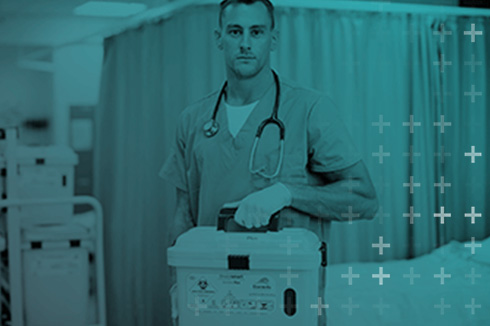
Sharpsmart: Size and Location Impact on Sharps Injuries
Where Sharps Safety Delivers Measurable ImpactThis 6-year study examined the impact of converting from a small patient room sharps container to the Daniels Sharpsmart reusable collector.
Safer Handling from Point of Use to the Dock
Safety is built into how waste moves through a hospital. Daniels helps EVS and clinical teams follow safer handling behaviors from patient rooms to soiled utility rooms and through to the loading dock, reducing risk at every touchpoint.
Our accessories support secure, consistent mounting and correct placement. Purpose-built transporters, trolleys, and carts reduce heavy lifting and double-stacking, improve maneuverability in tight corridors, and create a more stable, ergonomic way to move waste across the facility. The result is fewer handling risks, smoother workflows, and a safer back-of-house environment.
We place safety first.
Safety is the north star of Daniels operations. From labor planning and logistics to container innovation and ergonomic handling, we design every step to reduce risk and protect the people who deliver care.
That safety culture continues through education, audits, and ongoing performance support. We help hospitals embed safer habits associated with waste disposal and handling, strengthen compliance, and drive measurable change across the life of the partnership.