Flu Season Is Here: What You Should Know

As the air gets a little colder and the leaves begin to change, we know that fall is officially here. But for those in the healthcare industry, fall season means something else, the start of flu season.
Vaccinations surge and patient visits increase during this time of year, putting more demand on a hospital. This means, more sharps and regulated medical waste (RMW) being generated.
Here at Daniels, we want to make sure healthcare workers and facilities stay protected during flu season. Preparing for seasonal increases and refreshing your knowledge of proper handling protocols is essential for maintaining safety.
WHAT YOU NEED TO KNOW:
- Flu Season’s Impact on Medical Waste
- Maximize Flu Shots, Minimize Risk
- Sharpen Your Safety Habits
- Does Having the Flu Mean More Red Bag Waste?
- Don’t Face Flu Season Alone: Choose Daniels Health
Flu Season’s Impact on Medical Waste
With an increase in vaccinations, flu season creates more medical waste.
You are likely to see more of the following:
- Hypodermic needles
- Syringes
- Vaccine Vials
- Alcohol Swab
- Gloves
- Masks
- Specimen collection swabs/ tubes
Meaning, more medical waste generation within your four walls!
 Maximize Flu Shots, Minimize Risk
Getting an annual flu shot is one of the most important steps a person can take to protect their health and the health of their community.
It’s the best defense against the flu. The vaccine is effective at reducing the severity of the illness. Meaning, even if someone catches the flu, their symptoms will likely be much milder.
Data from the Centers for Disease Control and Prevention (CDC) highlight this impact: flu vaccination prevented an estimated 7 million influenza illnesses and 3 million influenza-associated medical visits in recent seasons. In seasons when vaccine viruses are closely matched to the circulating strains, the flu shot has shown to reduce the risk of having to visit a doctor with the flu by 40 to 60%.
Flu vaccinations are great for public health. However, they bring a challenge for our medical professionals: an increase in the number of sharps being handled.
Every time a healthcare worker administers a vaccine, they are at risk of a needlestick injury. An estimated 30 million-plus healthcare workers already face the possibility of obtaining sharps injury. Cuts, punctures, tears and other injuries from improperly handled, used sharps are a hazard in every medical environment.
This is a serious and daily risk; but in some cases, these injuries are preventable. The CDC estimates that 62% to 88% of sharps injuries can be avoided with safer medical devices and proper disposal practices.
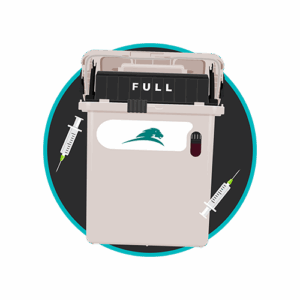
At Daniels our sharps containers are proven to deliver:
- 86.6% reduction in needle stick injury
- 100% reduction in container associated sharps injuries
- 83% reduction in disposal related sharps injuries
- 85% reduction in recapping sharps injuries
 Sharpen Your Safety Habits
The improper disposal of sharps elevates the risk of needlestick injuries, which can expose staff to severe bloodborne pathogens. Protecting your team starts with implementing best practices for disposal.
Review these key reminders:
Dispose at the Point of Generation
The biggest rule for handling sharps is to dispose them immediately after use. Place the needle directly into a sharps container right where it was used. You should never carry an uncapped needle across a room.
Never Recap Needles
Recapping is a leading cause of needlestick injuries. Studies have shown that implementing a “no recapping” policy can reduce needlestick injuries by two-thirds.
Use Proper PPE
Always wear the appropriate personal protective equipment (PPE), to protect against contact with infectious materials. For example, using double gloves can significantly reduce the risk of a needlestick injury.
Proper Container Reminders:
- Never overfill: Once a container reaches the fill line, it’s time to replace it. (Fun Fact: once our sharps containers are full, it is impossible to fill it.)
- Place containers correctly: Position sharps containers at eye-level and within arm’s reach. (Fun fact: our accessories ensure your container is placed right where you need it.)
- Pass the candy test: Ensure the container opening is small enough so that no one can reach a hand inside. (Fun Fact: our containers pass the “candy test.”)
- Do not open or empty full containers: Only properly trained professionals should open and empty containers. (Fun Fact: our containers have a locking mechanism, ensuring no one can open unless it is a trained professional.)
 Does Having the Flu Mean More Red Bag Waste?
If a patient has the flu, does that automatically mean more Red Bag Waste, properly known as Regulated Medical Waste (RMW), is produced?
The answer is: No.
Let us explain why.
What Exactly is Regulated Medical Waste?
Simply put, RMW is the material medical facilities must handle with extra caution.
Why?
Because it’s been contaminated with blood, body fluids, or other materials that could pose a significant risk of transmitting infection. It goes by many names; you might hear it called biohazardous waste, biomedical waste, infectious waste, or red bag waste.
Subcategories of RMW:
- Sharps Waste: This is any device used to puncture or lacerate the skin. (Examples: Hypodermic needles, scalpels, lancets, and broken glass or rigid plastic contaminated with blood.)
- Pathological Waste: Defined as any human or animal body parts. (Examples: Organs, tissues, surgical specimens and bodily fluids removed during surgery or autopsy.)
- Anatomical Waste: This is a subcategory of pathological waste comprising materials that are recognizable human, such as an amputated limb.
Your Flu Patient Doesn’t Create RMW
A key point to remember is not all waste generated by a patient is considered RMW.
Imagine your facility during peak flu season. A patient uses a handful of tissues, coughs into them, and discards them in the bedside bin.
Is that RMW?
Absolutely not.
While standard infection control practices are essential, you don’t need to treat every disposable item as biohazardous.
The tissues, empty medicine cups and oxygen concentrators used by a flu patient do not meet the criteria for being blood-soaked. Therefore, they are treated as regular hospital waste.
Only if the waste meets the definition of RMW or one of its subcategories should it be treated as medical waste.
This distinction is vital. It prevents the over-classification and mismanagement of waste, ensuring the right waste streams go to the right place while keeping disposal costs and environmental impact manageable.
 Don’t Face Flu Season Alone: Choose Daniels Health
Flu season puts healthcare facilities on high demand. While you focus on administering flu shots and patient care, let us handle your staff protection and waste management.
At Daniels Health, safety is at the core of our brand, year-round. From our education protocols to the enhanced safety features in our Sharpsmart, we want to be your unwavering safety partner.
Connect with Daniels Health today to ensure your facility is fully prepared for the demands of the season while maintaining healthcare, uninterrupted.
The flu is tough. Your safety partner shouldn’t be.

Erika Safrin
Let's Talk!
Your time is valuable, and we don’t want to play hard to get. You can either phone us directly on the details listed on our contact page, or feel free to fill out this short form and one of our team members will get back to you as quickly as possible.